 admin | 2025-06-19 |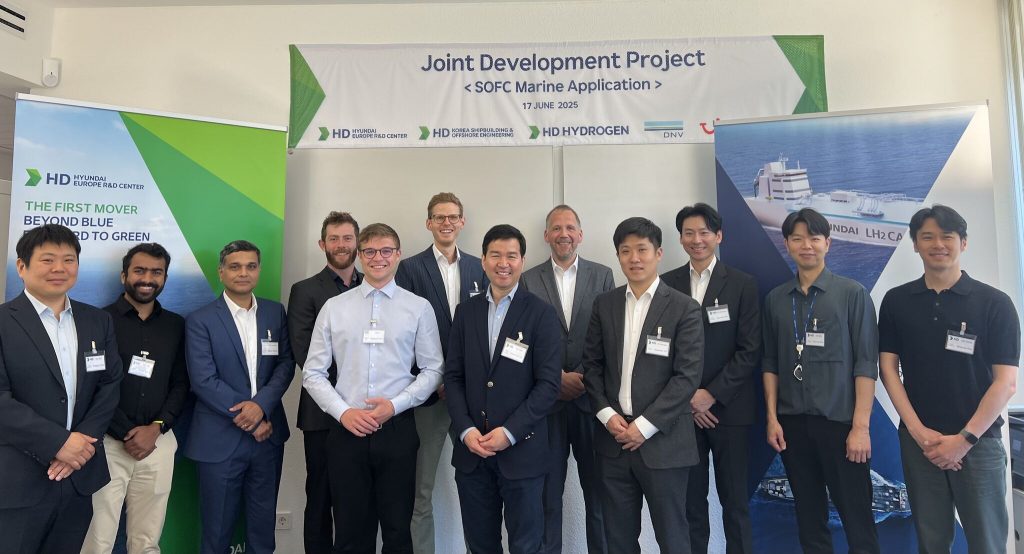
Joint Development Project with DNV and TUI Cruises to advance maritime decarbonization
HD Hyundai announced the development of fuel cell technology for cruise ships, reinforcing its commitment to global decarbonization efforts in the maritime industry.
HD Korea Shipbuilding & Offshore Engineering (HD KSOE), HD Hyundai Europe Research and Development Center GmbH, and HD Hydrogen have signed a Joint Development Project (JDP) agreement with DNV, a leading global classification society, and TUI Cruises, one of Germany’s premier cruise operators. The collaboration aims to explore the application of Solid Oxide Fuel Cell (SOFC) systems on cruise vessels.
Why SOFC for Cruise Ships?
Cruise ships and SOFCs are a strong match for a more sustainable future:
- Seamless integration – Cruise ships have constant electric power demand and already utilize electric propulsion. SOFCs can replace one engine in the genset without requiring a complete powertrain redesign.
- Cost-effective adoption – There is no need to replace the entire genset. Installing SOFCs to supply around 20% of the power can already cover the base load, meeting up to 60% of the energy demand while reducing investment costs and significantly increasing energy efficiency.
- No methane slip – Unlike four-stroke combustion engines, SOFCs do not emit methane. CH4 slip is becoming increasingly relevant due to the latest regulations, as it contributes to the GHG footprint considered under FuelEU Maritime and the IMO midterm measures.
About SOFC Technology
SOFC is a high-efficiency fuel cell that generates electricity by reacting hydrogen extracted from sources such as natural gas or ammonia with oxygen. Since it produces electricity without combustion, it significantly reduces carbon and pollutant emissions.
Compared to conventional engine-based power generation systems, SOFC offers superior efficiency, achieving both environmental sustainability and economic viability. With low noise and vibration levels alongside high power generation efficiency, it is especially suitable for cruise ships that require large amounts of electricity.
Project Scope
As a first step, HD KSOE and HD Hyundai Europe Research and Development Center GmbH will establish safety design standards for applying SOFC systems to cruise ships over an eight-month period from June 2025 to February 2026. HD Hydrogen will analyze the performance of its proprietary SOFC systems under various operating conditions.
Additionally, HD Hyundai will develop technologies to recover and reuse waste heat generated by SOFC systems, which operate at high temperatures ranging from 600 C to 1,000 C. The company also plans to explore carbon capture and storage (CCS) technologies to further reduce emissions.
Partner contributions:
- DNV – Regulatory compliance support and safety guidance from initial design
- TUI Cruises – Cruise ship-specific data, installation requirements, and operational specifications
Market Outlook
The global SOFC market shows strong growth potential. According to Grand View Research, the market is expected to grow at a compound annual growth rate (CAGR) of 40.7% through 2030, reaching approximately USD 7.12 billion, driven by increasing demand and investment in clean energy.
Strategic Focus
HD Hyundai plans to secure global competitiveness by developing SOFC technology with a focus on the European market, where environmental regulations are stringent and demand for sustainable cruise vessels is high.
“This international joint development project marks a significant milestone in demonstrating HD Hyundai’s world-class decarbonization technology for ships in the European market. We aim to lead the maritime decarbonization initiative through our low-carbon, high-efficiency fuel cell technology.”
– Representative, HD Hyundai